Key Takeaways
- Understanding the types of book editors is essential for turning a rough manuscript into a polished, publication-ready book.
- Editing is a multi-stage process that goes beyond grammar and includes structure, clarity, tone, and consistency.
- Developmental editors focus on the big picture, including story structure, plot flow, pacing, and character development.
- Line editors refine sentence-level writing by improving flow, readability, tone, and word choice without changing meaning.
- Copy editors ensure technical accuracy by correcting grammar, spelling, punctuation, and style consistency.
- Proofreaders provide the final quality check before publishing by removing minor errors and formatting issues.
- Publishing editors work within publishing houses and manage manuscript selection, editing direction, and production coordination.
- The editing process follows clear levels of editors, where each stage builds on the previous one for complete refinement.
- A book editor improves structure, readability, and engagement while maintaining the author’s original voice.
- Choosing the right editor for a novel depends on genre, experience, editing stage, and manuscript needs.
- The idea that editors “remove creativity” is a misconception; instead, they strengthen clarity and impact.
- Professional editing significantly increases the chances of successful publishing and reader engagement.
Ready to Publish a Professional Quality Book?
Your manuscript deserves expert attention before it reaches readers. With professional editing, your ideas become clearer, stronger, and publication-ready.
Introduction
Every manuscript begins as an idea, but it is rarely ready for publication in its first draft. In fact, most writers discover that their work needs refinement, structure, and clarity before it can truly shine. This is exactly where professional editing becomes essential. At Authors Breeze, we understand that strong editing is the backbone of successful publishing, because every great book is shaped through expert revision.
Moreover, many writers often struggle to understand the types of book editors involved in the publishing process. As a result, confusion arises about who does what, when they are needed, and how they improve a manuscript. Therefore, understanding editorial roles becomes a crucial step for every author aiming for publication.
In this blog, you will learn everything about editing roles, levels, responsibilities, and how each editor contributes to turning a draft into a polished book.
What Are Editors and Why Do They Matter?
To begin with, editors are professionals who refine written content to improve clarity, structure, accuracy, and readability. Although writing comes from creativity, editing ensures that creativity is effectively communicated.
Furthermore, editors play a major role in shaping manuscripts so they meet publishing standards. Without them, even strong ideas may fail to reach readers clearly.
In addition, editing goes far beyond grammar correction. Instead, it focuses on flow, consistency, tone, structure, and overall readability. Therefore, editors are essential collaborators in the publishing journey.
Key roles of editors include:
- Improving readability and flow
- Enhancing structure and coherence
- Correcting language and grammar issues
- Preparing manuscripts for publication
Consequently, editing transforms raw writing into professional-quality work that is ready for readers.
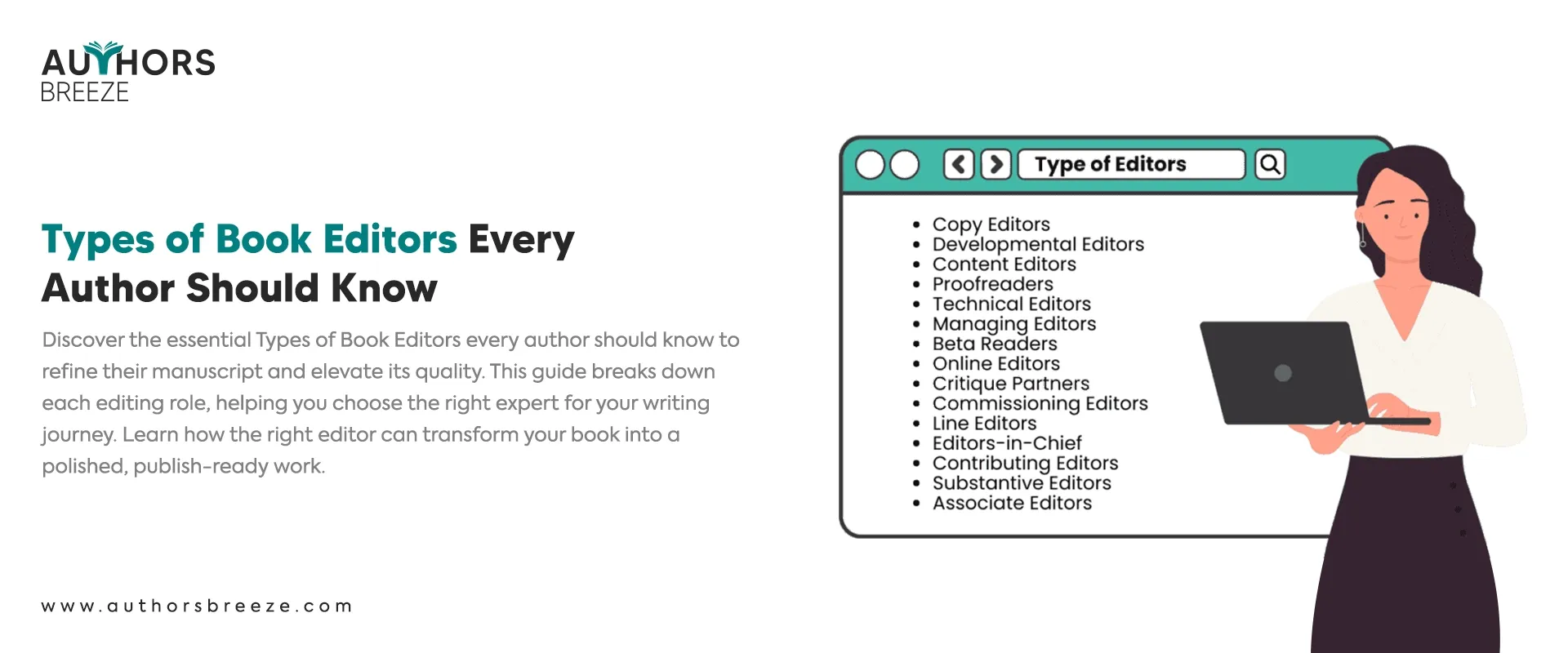
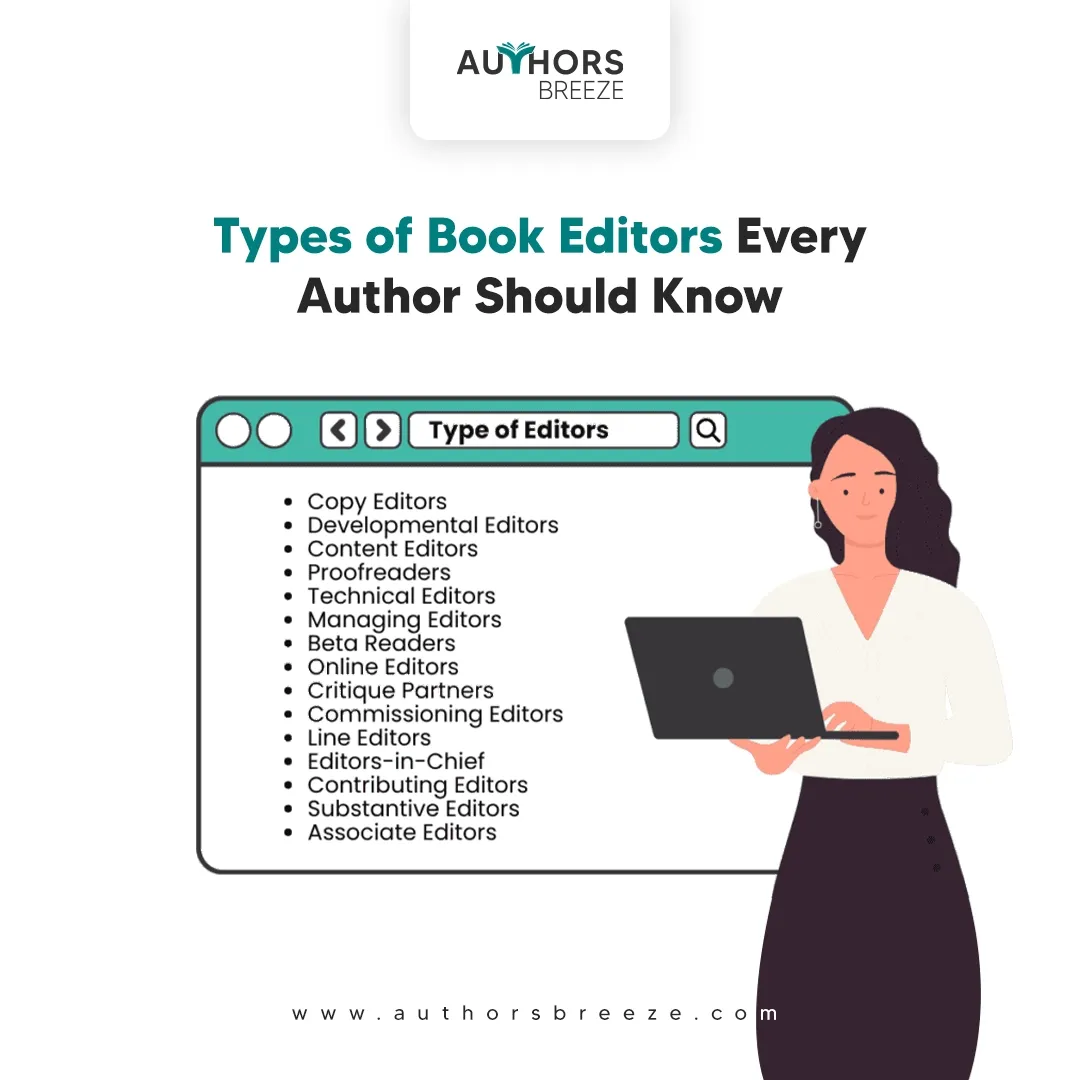
Types of Book Editors
Understanding the types of book editors is extremely important because each editor performs a unique function. Moreover, every stage of editing builds upon the previous one, ensuring complete refinement of a manuscript.
1. Developmental Editors
First and foremost, developmental editors focus on the big picture of a manuscript. They analyze structure, plot, pacing, character development, and overall storytelling quality.
Additionally, they help authors strengthen weak areas in the narrative. For example, if a story feels rushed or unclear, developmental editing provides structural improvements.
They typically work on:
- Story structure
- Plot development
- Character arcs
- Chapter organization
Therefore, this stage is often considered the foundation of editing.
2. Line Editors
Next, line editors focus on sentence-level improvement. Unlike developmental editors, they do not change the story structure. Instead, they refine language, tone, and flow.
Moreover, they ensure that each sentence reads smoothly and naturally. As a result, the writing becomes more engaging and polished.
They improve:
- Sentence clarity
- Word choice
- Tone consistency
- Flow and readability
In short, line editing enhances how the story is told.
3. Copy Editors
After that, copy editors focus on technical accuracy. Grammar, punctuation, spelling, and consistency are carefully checked at this stage.
Additionally, style guides are followed to ensure uniform formatting throughout the manuscript. Consequently, the text becomes error-free and professional.
They handle:
- Grammar correction
- Spelling and punctuation
- Style consistency
- Fact-checking
Thus, copy editing ensures correctness in every detail.
4. Proofreaders (Final Stage)
Finally, proofreaders perform the last review before publication. At this stage, only minor errors are corrected.
Furthermore, formatting issues, typos, and overlooked mistakes are removed. Since this is the final step, accuracy is extremely important.
They check:
- Typographical errors
- Formatting issues
- Missed punctuation mistakes
- Final presentation quality
Therefore, proofreading ensures that the manuscript is fully publication-ready.
5. Publishing Editor
In addition, publishing editors work within publishing houses and manage the entire editorial process. They often decide which manuscripts to get published. Moreover, they coordinate between authors, editors, and production teams.
They are responsible for:
- Manuscript selection
- Editorial direction
- Author communication
- Publishing decisions
As a result, publishing editors play a strategic role in the traditional publishing industry.
Fix Grammar, Structure & Flow with Experts
From sentence clarity to final proofreading, our editing experts ensure your manuscript meets industry publishing standards.
Levels of Editors in the Publishing Process
The editing process follows a structured hierarchy. Each level builds on the previous one to ensure complete refinement.
Typically, the workflow includes the following types of editing:
- Developmental Editing – structure and storytelling
- Line Editing – style and readability
- Copy Editing – grammar and accuracy
- Proofreading – final polish
Furthermore, this layered process ensures that no issue is left unresolved. Consequently, the manuscript becomes stronger at every stage.
What Does a Publishing Editor Do?
A publishing editor plays a broader role compared to other editors. Not only do they review manuscripts, but they also make publishing decisions.
Additionally, they evaluate market trends and determine which books have commercial potential.
Their responsibilities include:
- Selecting manuscripts for publication
- Guiding revisions
- Managing editorial teams
- Coordinating production processes
Thus, publishing editors connect creative writing with the publishing industry.
Editor Structure in Publishing
The editorial structure in publishing is highly organized. Each editor contributes at a specific stage, ensuring a smooth workflow.
The structure typically follows:
Author → Developmental Editor → Line Editor → Copy Editor → Proofreader → Publishing Editor
Furthermore, this structured approach ensures consistency, accuracy, and quality at every level. As a result, the final book becomes professionally refined.
Finding an Editor for a Novel
Finding the right editor is extremely important for any writer. However, the selection process should be based on manuscript needs rather than convenience.
Moreover, different editors specialize in different genres and editing levels.
When choosing an editor, consider:
- Experience in your genre
- Portfolio and sample work
- Editing stage required
- Budget and service scope
In addition, freelance editors and publishing house editors offer different advantages. Therefore, careful selection improves the final outcome significantly.
Common Misconceptions About Editors
Many writers believe that editors remove creativity from a manuscript. However, this is not true.
Instead, editors refine writing while preserving the author’s voice. Although changes are made, they aim to strengthen meaning rather than reduce originality.
Moreover, the idea that “editors take it out” is often misunderstood. In reality, unnecessary elements are removed so that the core message becomes clearer.
Consequently, editing enhances creativity rather than limiting it.
Types of Book Editors Comparison Table
| Editor Type | Focus Area | Stage | Purpose |
| Developmental Editor | Structure & storytelling | Early stage | Fix big-picture issues |
| Line Editor | Language & flow | Middle stage | Improve readability |
| Copy Editor | Grammar & consistency | Later stage | Ensure accuracy |
| Proofreader | Final corrections | Final stage | Polish manuscript |
| Publishing Editor | Selection & management | Industry stage | Oversee publication |
Conclusion
In conclusion, understanding the types of book editors is essential for every author who wants to publish a professional-quality book. Since each editor plays a unique role, the entire process works like a structured system that improves writing step by step.
Moreover, from developmental editing to proofreading, every stage ensures that your manuscript becomes clearer, stronger, and more engaging. Therefore, professional editing should never be overlooked.
At Authors Breeze, we support writers throughout their publishing journey by helping them refine, edit, and prepare their books for success. Ultimately, strong editing leads to strong publishing outcomes.
FAQs
What does a book editor do?
A book editor improves the structure, clarity, grammar, and overall readability of a manuscript.
What is the difference between a publisher and an editor?
An editor improves the manuscript, while a publisher handles printing, marketing, and distribution.
How do I find an editor for a novel?
You should review experience, genre expertise, portfolio, and editing level before choosing an editor.
What are the levels of editors in publishing?
The levels include developmental editing, line editing, copy editing, and proofreading.
Your Manuscript Deserves a Professional Touch
Every story has potential—but the right editing brings it to life in its strongest form. Let Authors Breeze refine your work with expert care.

Charles Maynes
Charles Maynes is a seasoned writer with years of experience in the publishing industry. With a background in journalism and creative writing, he deeply understands the art of storytelling and the importance of crafting a compelling narrative. Throughout his career, he has worked with a range of clients, from bestselling authors to small business owners, helping them to bring their stories to life through the written word.